Pre-Wedding Talks: 5 Crucial Conversations to Have Before Marriage
Reviewed by: Kara Francis
March 13, 2026
There is a lot of noise in the engagement season.
Venues. Dresses. Guest lists. Registries. Honeymoons.
But very few couples slow down long enough to ask the quieter question:
Who are we becoming as we enter this marriage — and who am I within it?
As a former divorce attorney turned identity-focused marriage and divorce coach, as well as someone who has personally been married, divorced, and remarried, I have seen countless times what happens when these conversations don’t happen early.
If a couple gets divorced, it’s usually not because of one dramatic event.
Instead, it usually looks like this: Drifting apart.
Avoiding conflict. Making assumptions. Silently adapting to roles that were never consciously chosen. And over time, the misalignment compounds.
The couples who build lasting, grounded marriages aren’t the ones who avoid hard conversations. They’re the ones who have them — clearly, calmly, and honestly — before vows are even exchanged.
These are the five conversations I believe every engaged couple should have before getting married.
This isn’t a checklist or promise of perfection. It’s about intentional and consistent effort to build a marriage based on identity, agency, and aligned expectations.
1. Who Am I — Independent of This Relationship?
Many people enter marriage having spent years defining themselves through roles that were inherited by or expected of them: student, partner, achiever, caretaker, oldest daughter, fixer.
Marriage magnifies whatever identity you bring into it. So if you don’t know who you are outside the relationship, you risk unconsciously shaping yourself around it. Clarity about personal identity now prevents resentment later.
Ask yourselves, individually:
- What values do I want to live my life by?
- What people/places/situations make me feel most like myself?
- What parts of me feel muted or overextended right now?
- What do I need in order to feel whole — not just partnered?
This isn’t about independence for independence’s sake. It’s about self-awareness. Because the strongest marriages are built by two whole individuals — not two halves hoping to complete one another.

2. What Does “Marriage” Actually Mean to Each of Us?
Couples assume they share a definition of the meaning of marriage. But in reality, we often have different perspectives and expectations.
For one partner, marriage may symbolize stability and loyalty. For the other, it may represent growth, evolution, and emotional depth.
Some see marriage as a permanent commitment, no matter what happens. Others see it as conditional upon mutual effort and alignment.
None of these perspectives are inherently wrong. But unspoken differences can become fault lines over time.
Before the big day, discuss:
- What does “commitment” mean to you?
- What would feel like a breach of that commitment?
- How did your parents’ marriage shape your expectations?
- What are you unwilling to repeat from prior relationships or the relationships you witnessed growing up?
Marriage is not just a legal contract or religious event. It is also a shared philosophy.
If you don’t articulate that philosophy together, it’s easy to default to inherited models — cultural, religious, or familial — that may not actually fit who you are becoming.
This is your marriage story, and you get to write it – together.
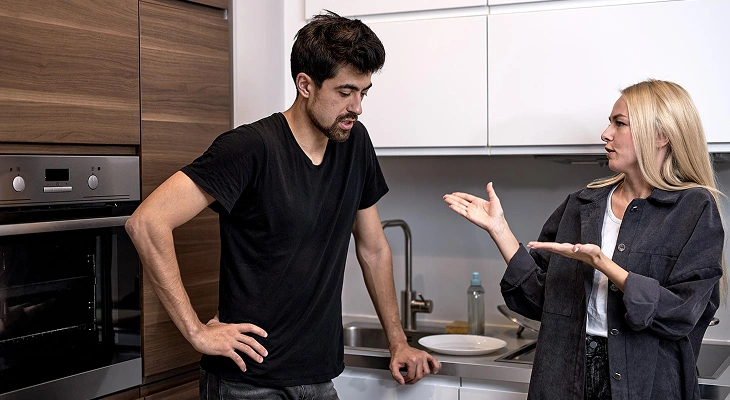
3. How Will We Handle Conflict?
Every couple fights. The issue is not whether conflict will happen. It’s how you navigate it when it does.
In my years practicing divorce law and in my personal experience with marriage and divorce, I saw a pattern: It wasn’t the presence of conflict that ended marriages. It was the erosion of emotional safety and trust within the conflict.
Pre-wedding, think about and discuss these questions:
- When I’m hurt, do I tend to shut down or escalate?
- How does each of us respond to criticism?
- What makes each of us feel heard?
- What makes each of us feel dismissed?
- Are we capable of growth and evolution if something isn’t working?
Conflict handled with curiosity and respect builds trust. Conflict handled with defensiveness creates distance.
Are you both willing and able to examine patterns and take accountability, rather than blaming one another when challenges arise?
4. How Will We Make Big Life Decisions?
Children.
Finances.
Careers.
Location.
Lifestyle.
These conversations are often framed as logistical. But they’re not. They’re identity-based.
One partner may prioritize career mobility and adventure. The other may crave rootedness and stability.
One may envision children as essential. The other may feel ambivalent or certain they don’t want them.
Again, none of these perspectives is inherently “wrong.” But a marriage cannot thrive if one person consistently overrides their internal “no” to preserve relationship harmony and longevity.
Avoid vague “agreements” like:
“We’ll figure it out later.”
“We’ll see how we feel when the time comes.”
“It’ll work itself out.”
This is just kicking the proverbial can down the road and can lead to more tension and conflict later, after you’ve already invested years in the relationship assuming the other person would cave to your desires.
Instead, ask each other:
- If we disagree on a major life decision, how will we decide?
- What values guide our life choices?
- What feels non-negotiable to each of us?
- What feels flexible?
Alignment does not require identical desires. But it does require honesty about where compromise feels sustainable, as opposed to compromise that causes you to drift away from your own truth.
5. What Does Growth Look Like — Individually and Together?
You will not be the same person in ten years that you are today.
That’s not a threat. It’s a fact. The only “constant” in life is change. One of the only guarantees in life is that nothing stays the same.
The healthiest marriages don’t resist evolution. They create space for it.
Discuss:
- How do we support each other’s growth?
- What happens if one of us changes direction professionally or personally?
- Are we open to revisiting expectations as we evolve?
Many couples unconsciously enter marriage assuming the current version of their partner is permanent.
But people expand. Desires shift. Values deepen. Ambitions change.
The question isn’t whether change will happen. It’s whether your marriage is structured to ebb and flow with it.
A rigid marriage fractures under pressure. A flexible one adapts.
Final Thought
A wedding is a single day.
A marriage is an evolving identity container.
The couples who do well long term are not the ones who avoided deep conversations before the wedding.
They are the ones who practiced honesty early, even when it felt scary and uncomfortable.
If you are engaged and reading this, consider this an invitation: Slow down. Have these conversations.
Not to prove you’re perfectly compatible, but to ensure you are choosing each other consciously, clearly, and from a place of wholeness.
Kara Francis Coaching can guide you through these essential conversations, helping you to prepare for a marriage that thrives on honesty and mutual understanding.
Because the strongest marriages aren’t built on hope. They’re built on truth.